
KHALISTAN EXTREMISM MONITOR
A project of the Institute for Conflict Management
A project of the Institute for Conflict Management
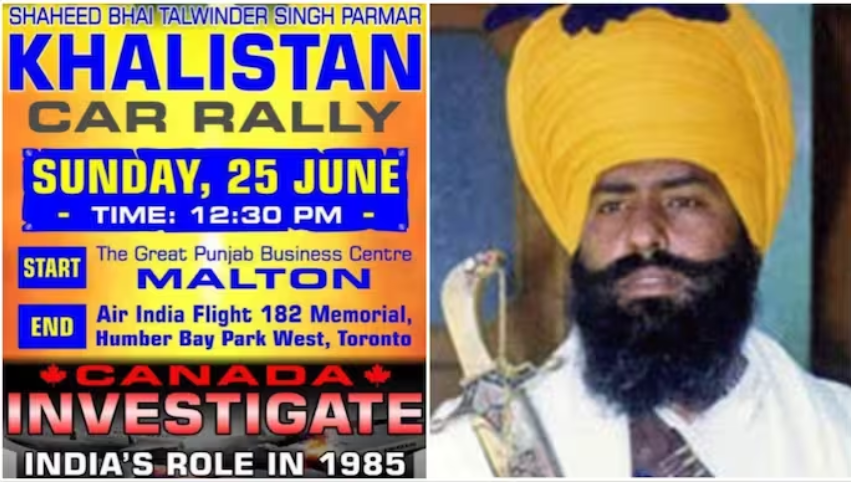
Posters
of a pro-Khalistan rally, glorifying Talwinder Parmar - the alleged mastermind
of the 1985 Air India bombing, were seen across several places in Canada.
The
poster referred to the separatist leader as 'Shaheed Bhai Talwinder Parmar' and
advertised a car rally, scheduled for June 25 (Sunday), at 12.30 pm (local
time).
Further,
the poster sought an investigation into "India's role in 1985 Kanishka
bombing".
The
development comes amid pro-Khalistan attacks on the Indian High
Commission in Canada,
other than in the UK and the US.
Taking
to Twitter, Terry Milewski, retired CBC correspondent and author of "Blood
for Blood - Fifty Years of the Global Khalistan Project", said Canadian
Khalistanis have again picked as their poster boy, the psychopath who bombed
Air India - Talwinder Parmar.
"Ensuring
that their reputation stays at rock-bottom, Canadian Khalistanis again pick as
their poster boy the psychopath who bombed Air India, Talwinder Parmar. He
murdered 331 innocents for nothing. And - a grotesque twist - he'll be honoured
at the memorial to his victims," Terry Milewski wrote on Twitter.
In
a series of tweets, the author said, "It's another mad bid to whitewash
Canada's worst-ever mass-murderer by demanding that Canada "investigate
India's role" in the bombing. But decades of investigations proved that
India had no such role and that Parmar led the bomb plot. The rally is about
spreading a lie."
1985 AIR INDIA BOMBING AND INVESTIGATION
On June 23, 1985, Air India Flight 182, carrying 329 passengers and crew
members, was blown mid-air off the coast of Ireland while en route from Toronto
to London. The bombing resulted in the loss of all lives on board. As per
initial speculation, Sikh extremists were accused of sabotaging the flight and
one suspect was convicted in 2003.
The sequence of events began when Canadian officials discovered three
suspicious packages during a routine stop in Montreal. The packages were
subsequently removed from the aircraft before it continued its journey to
London.
Approximately 45 minutes before reaching its destination, the plane
disintegrated mid-air without any warning or distress calls being issued.
Following the disappearance of the aircraft from radar screens,
emergency rescue teams were immediately dispatched to the scene. However, no
survivors were found. The rescue teams managed to recover 131 bodies from the
sea.
Airline officials initially suspected Sikh extremists of planting a bomb on the Air India flight. Subsequently, two suspects were arrested two months after the tragic incident.
Canadian
police alleged that Talwinder Singh Parmar was the mastermind behind the
attack. However, charges against him were dropped. Parmar was later killed by
the police in India.
The
other suspect, Inderjit Singh Reyat, a Sikh residing in Vancouver, pleaded
guilty to manslaughter in connection with the bombing.
In
2003, Reyat was sentenced to five years in prison.
It
is worth noting that Reyat had previously received a 10-year prison sentence
for his involvement in building a bomb that killed two baggage handlers at
Japan's Narita Airport on the same day as the Flight 182 disaster.
Two
additional suspects, Ripudaman Singh Malik and Ajaib Singh Bagri, were arrested
in 2000, but they were acquitted in 2005 due to insufficient evidence.
In 2006, a Canadian commission was established to conduct an inquiry
into the Air India Flight 182 bombing.
The commission released a five-volume report in 2010, which concluded
that the disaster was the result of a "cascading series of errors."
The report specifically highlighted the failure of Canadian intelligence
and security agencies to share crucial information with one another and their
engagement in "turf wars."
HOW CANADIAN PM TRUDEAU DESCRIBED 1985 AIR INDIA BOMBING
In 2018, 33 years after the 1985 Air India bombing, Canadian Prime
Minister Justin Trudeau described the incident as the "single worst
terrorist attack" in the country's history, as he paid tributes to the 329
victims.
"On this day in 1985, Canadians awoke to news that defied belief,
and left our country in a state of shock and suffering," Trudeau said,
marking the National Day of Remembrance for Victims of Terrorism in Canada.
"The Air India bombing remains the single worst terrorist attack in
Canada's history. This horrific act of malice and destruction left families and
friends grieving the loss of loved ones, and brought pain that will never
completely go away," the prime minister said.
"In times of tragedy and testing, Canadians have shown that the values which bring us together - inclusion, compassion, justice, and equality - are much stronger than the forces that try, and fail, to wedge us apart," Trudeau said.
"Terrorists
believe, through cowardly and violent acts, that they can make us question not
only our safety, but the democratic institutions that keep us safe. They are
wrong. Canadians are for facts and diversity, not fear and division. Our
society thrives on inclusivity, and these acts only strengthen our resolve for
unity," Trudeau said.
He
said, "Canada condemns all forms of terrorism. We stand in solidarity with
our allies, and the international community, in the ongoing fight to prevent
radicalization and fight terrorism at home and abroad".
"On behalf of the Government of Canada, I extend my condolences to
everyone everywhere who has lost loved ones to terrorism. We also thank and
honour those who work each day to keep our citizens, communities, and country
safe," he said, referring to several terror attacks across the world.